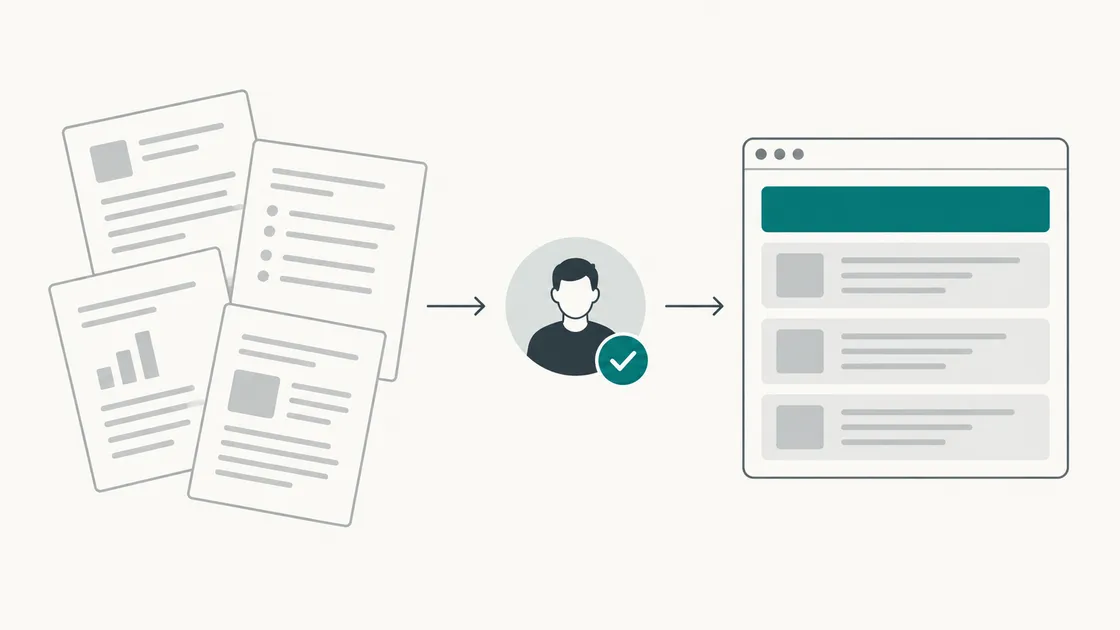
The information exists. The website copy doesn’t.
Many established businesses already hold useful material for their website. It’s just in the wrong shape and the wrong places — and some facts may need updating.
A service description written for a tender document. A brochure printed four years ago. An FAQ sheet the office manager assembled from the questions people actually ask. Email replies that explain the process better than anything published. Notes from a proposal that finally landed a good client.
The starting information may be there. What’s missing is the work of checking it and turning it into a website: deciding who each page is for, what order the information should come in, what to cut, and how it should sound when a stranger reads it cold.
That’s the gap this article is about — and where AI genuinely helps, as well as where it needs a person standing over it.
Which documents are useful?
Start with documents your business is authorised to use, then confirm that the details are still accurate.
Approved service descriptions. Material you’ve sent to a client, put in a tender, or published can be a useful starting point. Check that it still represents what you deliver today.
Brochures and printed material. Even dated ones can reveal how you’ve described your offer. Treat old claims, prices and contact details as unverified until checked.
Product or specification sheets. Particularly useful because they’re precise, and precision is what most website copy lacks.
FAQ documents and support notes. Frequently the single most valuable source, because they’re written in response to real questions rather than to impress.
Price lists, packages and terms. Even if you don’t publish prices, these tell us what the offer actually is.
Brand guidelines. Tone of voice notes, words you use and avoid, how you refer to your own services.
Recent proposals and winning pitches. They show how you’ve explained your offer, provided you have permission to use the material and remove client-confidential details.
One thing matters more than volume: current and accurate beats comprehensive. Twelve pages you’d be happy to stand behind today are worth more than a folder of ninety containing three versions of the same service page that disagree about what’s included.
If you send conflicting drafts, the review stage becomes an exercise in working out which version is true — which is slower, and it’s work only your team can actually do. Do that filtering before you send, and the whole project moves faster.
What content could they become?
Depending on what’s agreed in the brief:
- Homepage copy — the offer stated plainly, who it’s for, and the reasons to enquire
- Service page drafts — one per service, structured consistently: what it is, who it’s for, what’s included, what happens next
- A revised FAQ, deduplicated and rewritten for a reader who’s never met you
- Short summaries for cards, listings and navigation
- Page titles and meta descriptions
- About page material, drawn from the history and credentials scattered across your documents
Worth being clear: not every document becomes a page. Some sources contribute a paragraph. Some contribute one accurate figure. Some turn out to be unusable because they’re superseded. The deliverables are whatever the agreed scope says they are, and that’s settled before any work starts rather than discovered afterwards.
A simple example
The business below is invented for illustration. It isn’t a client, and nothing in it is drawn from real project work.
Imagine a small joinery firm. They have two documents: a six-page brochure from 2022, and a one-page FAQ sheet kept by the office.
The brochure contains a company history, a list of services written as a single dense paragraph, four project photographs, and a page of accreditations. The FAQ answers eleven questions, including how long a kitchen fit takes, whether they handle plastering, and what the deposit terms are.
From those two documents, a draft set of pages might look like this.
Homepage. The offer in one sentence, extracted from the services paragraph and sharpened: what they make, for whom, in which area. Three service summaries beneath it. The accreditations reduced to a single trust line. A clear next step.
A service page for fitted kitchens. Built mainly from the brochure paragraph and three of the FAQ answers — what’s included, typical timescale, what the customer needs to decide, and what happens after an enquiry.
An FAQ page. The original eleven questions, rewritten so each answers in its first sentence, with two merged because they asked the same thing differently.
A list of gaps. Three items the documents didn’t answer: whether they still cover the same geographic area, whether the 2022 deposit terms are current, and whether the accreditations are all still valid.
That last output is as important as the pages. It’s a short list of questions for the owner, not invented answers.
Where AI helps, and where a person checks
AI helps with extraction and the first draft. It can group related material, identify repeated claims and suggest a page structure. That can shorten early drafting, but the benefit depends on the quality, volume and consistency of the source material.
A person does the checking, and it’s not a formality. Specifically:
- Factual statements are checked against an approved source or confirmed directly by you. Unsupported claims don’t ship.
- Inconsistencies get resolved rather than averaged. When the brochure says five working days and the FAQ says a week, that’s a question for the client, not a judgement call for us.
- Clarity gets improved. First drafts tend toward long sentences and hedged claims. Someone cuts.
- Tone gets applied. Matching how the business actually speaks, which a machine approximates and a person recognises.
- Gaps get flagged. Marked clearly for the client to fill.
And the client approves the facts. Nothing about your services, timescales, coverage, qualifications or prices goes live because software produced it. It goes live because you read it and confirmed it’s true. That step isn’t optional and it isn’t ours to skip.
The short version: AI can help produce a useful starting draft. It doesn’t produce a finished page on its own.
When information is missing or sensitive
Missing
Gaps get queried or marked. They never get filled in with something plausible.
This is the single most important rule in the process, because a language model’s default behaviour is to produce something that reads well whether or not it knows the answer. A confident invented sentence about your accreditations, your response times or your coverage area is worse than an obvious blank — it’s wrong, it’s in your voice, and it may sit on your website for two years before anyone notices.
So drafts arrive with visible markers where information was needed and wasn’t available. Those get answered by you, not by us.
Sensitive
Some useful source material is confidential — client names in proposals, pricing you don’t publish, staff details, commercially sensitive specifications.
Don’t put confidential source material into the public enquiry flow. Our static website lets you describe your requirements and generate a PDF in your browser; it is not a document-upload service. If you choose to share that PDF by email or WhatsApp, keep sensitive document contents out of it.
The sequence we use: you describe what you have in general terms, we agree scope and a quote, and then we agree an appropriate way to transfer the actual files. If personal data is involved, we first agree how it will be handled.
If a document contains something that shouldn’t leave your building at all, redact it or leave it out. We’ll work with what we’re given and flag what’s missing.
What to prepare before enquiring
- Who the content is for — the audience in a sentence, per page if they differ
- What you want produced — homepage, service pages, FAQ, or “we’re not sure yet, help us decide”
- The documents you’d stand behind today, listed
- What to exclude — superseded brochures, discontinued services, old pricing
- Who approves the facts — one named person with authority to confirm what’s true
- Your deadline, and what’s driving it
- Anything confidential, identified but not sent yet
The third and fourth items save the most time. The fifth prevents the most rework — content projects stall when three people give contradictory feedback and nobody can settle it.
If you’re planning a whole new site rather than just the copy, our website launch checklist covers the rest of what you’ll need ready.
How we work
- Enquiry. You describe the business, the audience and roughly what you have. No source files through the public form.
- Scope and quote. We agree which pages are being produced, how many rounds of revision, the timeline, and what counts as done. The price is confirmed in a written proposal.
- Source transfer. We agree an appropriate channel and you send the approved material. We also agree how any personal data will be handled before transfer.
- AI-assisted drafting. Extraction, structuring and first-pass copy.
- Human review. Claims traced to sources, inconsistencies surfaced, clarity and tone worked on, gaps marked.
- Your feedback. You correct facts, answer the flagged questions and tell us what’s off.
- Final delivery. Finished copy in a usable format, ready to go into your site.
One thing stated plainly, because it’s occasionally asked: what you’re buying is reviewed content. Not prompts, not access to our internal tooling, not a system for generating copy yourself. The tools are how we work efficiently. The deliverable is pages you can publish, checked by a person, approved by you.
Tell us what you need
If you have material sitting in brochures, PDFs and old proposals and a website that needs writing, describe what you’ve got and what you’re trying to end up with. We’ll tell you honestly whether there’s enough there to work from.